
I Paused My Game To Be Here
Power Up this Spring with a curated series of video game films at Roxy Cinema.
For as long as I can remember, I have been inspired more by video games than arguably any other medium of art. As a filmmaker who is truly indebted to these digital worlds, it’s incredibly important to me that the work I create is always authentic to that experience. It’s a medium that’s been really close to my heart since my earliest memories, and it’s become a huge part of why I create. The thing about video games and film, though, is that we’re kind of just starting to see the cross-pollination between the two.
There’s been plenty of discourse regarding this merging of mediums over the years, with many tending to have a negative outlook on the process when it’s not, quote-unquote, true to the source material. However, this usually amounts to, “Oh, it’s not the same exact beat-for-beat story as the video game I remember watching the cutscenes for as a child.” In all honesty, that alleged bastardization is what precisely compels me. When it comes to straight-up adapting a video game, what matters most should be adapting the mechanics of the GAMEPLAY.
Story and character are undoubtedly an essential element of the “gaming experience.” But it’s when said story is told through the gameplay itself—the atmosphere, your interaction as a player, “leveling up” in the shoes of the characters—that the experience really sings, as opposed to, “Okay, time to put the controller down and watch a game try to imitate prestige television.” For the longest time, I’ve struggled to articulate this feeling to people not as well-versed on the matter. However, I’ve finally been given the opportunity to do so by the wonderful folks at Roxy Cinema.
My new repertory series of films co-curated and presented by Roxy Cinema, dubbed I PAUSED MY GAME TO BE HERE, aims to show what is truly possible when filmmakers (whether intentionally or not) learn the right lessons from these digital worlds. Films in the series include:
📀 George Lucas’s STAR WARS: EPISODE II – ATTACK OF THE CLONES (2002)
📀 Neveldine/Taylor’s GAMER (2009) (35mm)
📀 David Cronenberg’s EXISTENZ (1999) (New 4K Restoration)
📀 Hideaki Anno’s SHIN GODZILLA (2016)
📀 Zack Snyder’s SUCKER PUNCH (2011) (35mm)
📀 Christopher Nolan’s TENET (2020) (35mm)
📀 Christophe Gans’s SILENT HILL (2006) (35mm)
📀 Tony Scott’s DOMINO (2005) (35mm)
📀 Tony Scott’s DÉJÀ VU (2006) (35mm)
While some of these picks are either adaptations of pre-existing video game IP or films directly ABOUT video games as an industry, the majority of my choices for this series are pieces that I believe truly capture that feeling I’ve been trying to articulate for so many years.
Jargon-laden worldbuilding, expressionistic CGI, fixed camera angles, POV shots, mythic emotions, and much more are all abound in these works. They’re all very dear to me and part of the reason why I do what I do. I hope you can get just as much out of them as me while you’re AFK from your COD match. 🎮
Words by Heather Landsman
This May the Roxy Cinema is proud to present I Paused My Game to Be Here, a curated series of “video game films.” In most cases these are not films that are direct adaptations of video games, but rather films that, in their narrative, themes, production or release, replicate the logic, visual language, and ideology of video games. Video games, being a medium of the postmodern, then, offer an understanding of the logic of our time. This includes ideas around the promises and perils of technology, the distance from “reality” and the ontological and epistemological problems that come about in a hyper digitized world, and who or what holds power in societies of control.
For instance, 2002’s Star Wars Episode II: Attack of The Clones was one of the first Hollywood studio films shot entirely using digital cinematography – which some industry executives heralded as the death of “filmmaking.” In its release, director George Lucas rallied to have the film projected in movie theaters using the then new technology of digital projection. Few theaters made the switch, but in 2026 digital projection is the standard and analogue projection is an aberration. Like a power up you’re expected to use in a video game, technological advancements march forward with increasingly fewer options to opt out (in this way, our DCP projection of Attack Of The Clones is entirely what Lucas was hoping for).
Films like David Cronenberg’s 1999 Existenz and Mark Neveldine and Brian Taylor’s 2009 Gamer both are about groups of people who have, through bio-technological means, the ability to play “games” using one’s body and consciousness (in Gamer, the ability to hack into someone’s mind and body, in Existenz, the ability to play “virtual reality games” after the installation of “bio-ports” in one’s spine). Through these games, the question of what is real and what is not is collapsed on the bodily level, creating a schizophrenic world view. In the age of AI deepfakes, this questioning of reality feels more like the norm than an outlying experience.
In almost all video games there is a concept of a “tutorial,” where players are subjected to be trained in the logic and limits of the game’s world. Even in a seemingly entirely fantastical and expansive world there is a certain way a game must be “played.” Films like Wanted, Deja Vu, and Sucker Punch, feature in depth training sequences where the protagonist learns the way they must play in their own reality: while they may have advanced powers beyond the average person, they must grapple with things like disrupted causality, a collapsing of time, and the existence of multiple or parallel realities. Media scholar Deborah Levitt highlights the way that the training in these action blockbuster films mirrors the training the viewer also goes through in navigating new virtual environments. Our everyday is marked by similar such virtual environments that must be learned, like a soldier using new military technologies, or a normal person using something as mundane as a dating app. In some films, like Silent Hill, the cartographic exercise in mapping the terra incognita of the strange and horrifying world of Silent Hill leads to the protagonist’s (and viewers) cathartic release, and return to the world of “normalcy” transformed into something more. In the case of a film like Tenet, this logic is never fully understood, resolved or seen from the outside. As cultural scholar Fredric Jameson posits, this is the logic of postmodernism: an entrapment in world that promises possibilities but leaves one dizzied, dissociated, and at the threat of complete destruction (see Shin Godzilla’s post-Fukushima environmental and nuclear concerns).
I just completed a cyber security training at work recently, where I watched several hours worth of videos on how to know if an email from a coworker is real or a malicious AI deepfake sent by cybercriminals. At the end of every module I was asked to take a quiz, a sort of game. If I got a question wrong a smiling, condescending AI avatar would coach me, unblinking, through the correct answer. I thought about how these movies, already so nostalgic and quaint looking in the age of AI’s destabilizing forces, made technological advancement, and rebellion against it, look fun, sexy and dangerous, compared to the extremely unsexy way we encounter technology in our day to day. I thought about Deleuze’s concept of “societies of control,” the pervasive and modular ways that institutions modify and regulate human behavior and psychology beyond just top down disciplinary actions. At the heart of these “video game cinemas”, beyond their action packed assault on the senses, is a recognition of these controls and the desire to triumphantly transcend them. Or maybe it’s okay to sit down and enjoy the game. Bring your friends, sit around the TV (Roxy Cinema), and go ahead, press “new file.” Game, start.
Words by Carolyn Ramella
WORKS CITED:
Deleuze, Gilles. “Postscript on the Societies of Control.” October, vol. 59, 1992.
Grusin, Richard. “DVDs, Video Games, and the Cinema of Interactions.” Post Cinema: Theorizing 21st Century Film, edited by Shane Denson and Julia Leyda, REFRAME Books, 2016.
Jameson, Frederic. Postmodernism, or, The Cultural Logic of Late Capitalism. Duke University Press, 1991.
Levitt, Deborah. “The Subject of The Phantasm: Affect, Immersion and Difference in Avatar.” The Scholar and Feminist Online, issue 10.3, 2012.

Star Wars Episode II: Attack Of The Clones

Tenet
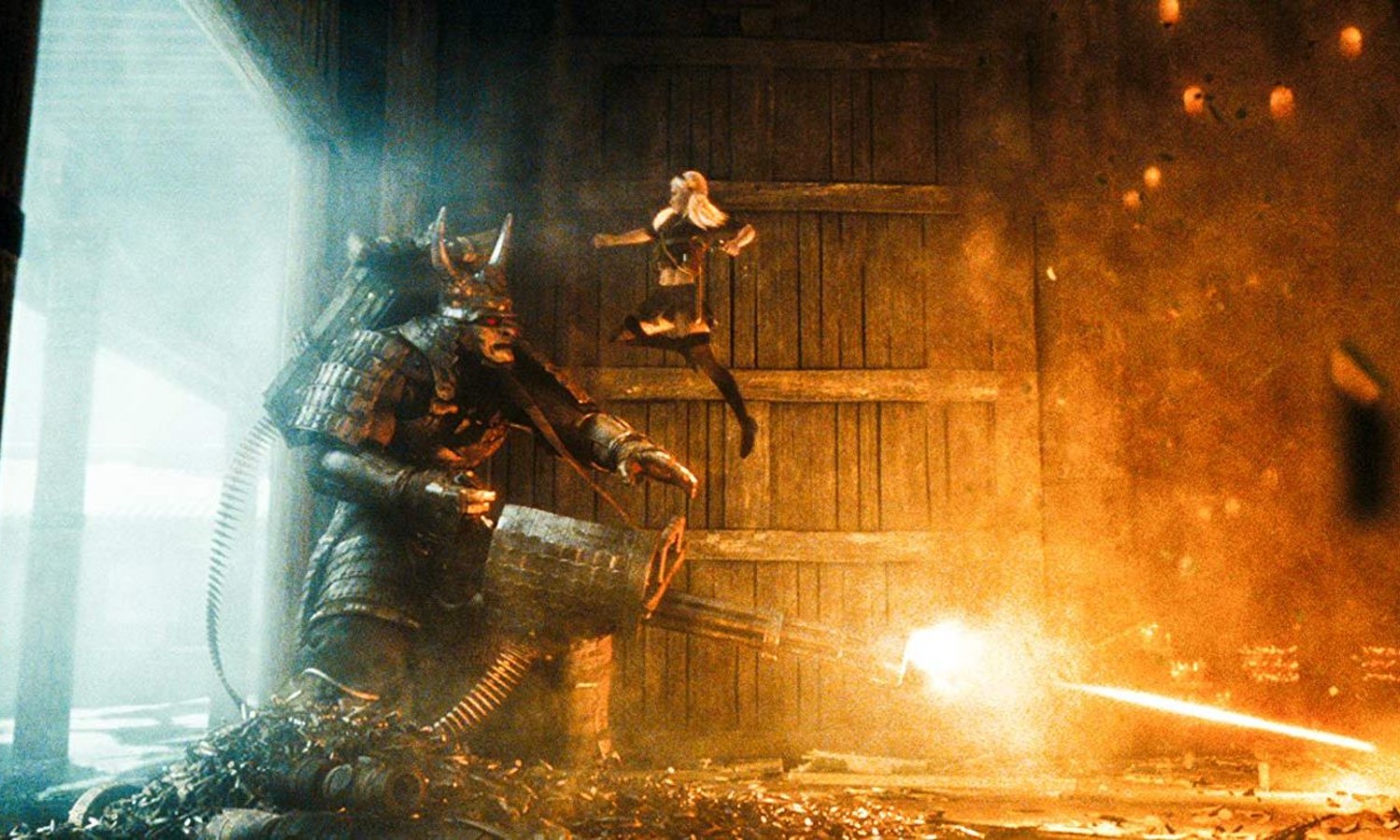
Sucker Punch
You May Also Like

Four by James N. Kienitz Wilkins
09.28.2026
On the occasion of the release of The Misconceived (2026), Roxy Cinema presents four films by filmmaker James N. Kienitz Wilkins.
Read More
Rick Prelinger's Lost Landscapes
09.17.2026
Roxy Cinema welcomes legendary archivist/filmmaker Rick Prelinger to present his participatory city symphony, LOST LANDSCAPES, for two special evenings this September and October.
Read More
JT Selects: Club Films - Movies that Inspired Club Cheetah
09.05.2026
Four club films as chosen by JT in anticipation of her upcoming album, Club Cheetah.
Read More